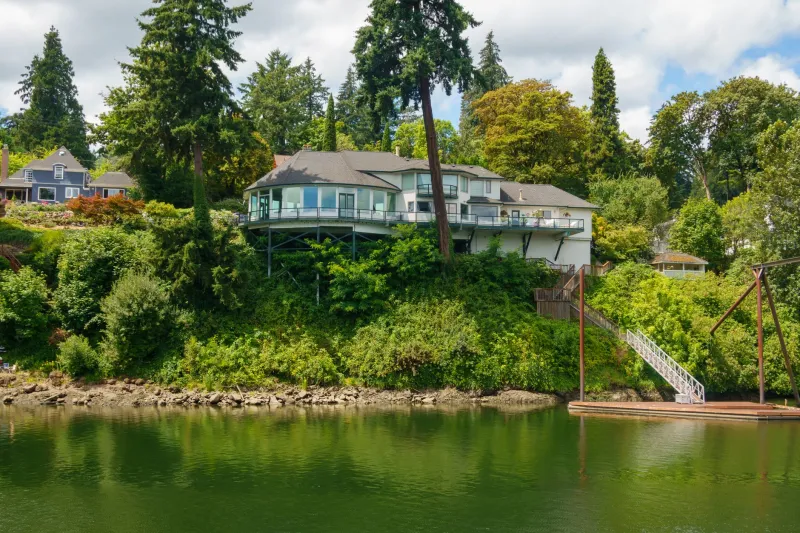
Invisible Boundaries: The Art and Science of Privacy on Luxury Riverside Properties

Photo by Photo by Jeffrey Eisen on Unsplash on Unsplash
Waterfront living presents a singular challenge: the very openness that makes riverside properties so desirable also exposes them to passing boats, neighboring parcels, and public recreational corridors. The most sophisticated riverside estates resolve this tension not through walls or fences, but through a layered discipline of design, landscape strategy, and technology that renders seclusion nearly imperceptible.
For the discerning buyer, understanding how privacy is engineered — rather than assumed — is essential to evaluating any premium riverside acquisition.
The Paradox of the Open Shore
Unlike a traditional estate set behind a gated motor court, a riverside home faces an inherently democratic body of water. Rivers in the United States carry a patchwork of public access rights, navigational easements, and recreational traditions that no amount of acreage can fully eliminate. A kayaker paddling the Hudson, a fishing vessel on the Tennessee, or a pleasure craft navigating the Sacramento all share legal right-of-way on the water itself.
This reality does not diminish the privacy potential of a riverside property — it simply demands a more intelligent approach to achieving it. The finest riverside estates in markets from the Columbia River Gorge to the Connecticut River Valley have demonstrated that true seclusion is not a function of distance from neighbors; it is a function of deliberate design.
Positioning and Topography as Primary Tools
Before a single tree is planted or a camera installed, the most effective privacy strategy begins with how a structure is sited on its parcel. Architects working in the luxury riverside segment increasingly favor positioning the primary residence set back from the water's edge, with secondary structures — a boathouse, a pavilion, a dock house — serving as the visible face of the property from the river.
This layered approach accomplishes two things simultaneously. It places the main living areas beyond casual sight lines from passing watercraft, and it creates a spatial hierarchy that guides both guests and the eye toward intentional points of arrival rather than unguarded exposures.
Topography further amplifies this strategy. Properties situated on elevated banks enjoy a natural visual advantage: the angle of observation from a vessel on the water is sharply limited, making interior spaces nearly invisible without any additional screening. When natural grade is absent, sophisticated grading work — berms, sculpted earth forms, and terraced hardscape — can replicate this effect with remarkable authenticity.
The Landscape as a Living Screen
No architectural element rivals mature, thoughtfully composed vegetation for its ability to establish privacy without the visual or psychological weight of a barrier. The best riverside landscape designers approach screening as an ecological composition rather than a utilitarian solution.
Native riparian species — river birch, bald cypress, black willow, and various species of native viburnum — offer the dual advantage of ecological appropriateness and layered visual density. Their irregular, naturalistic forms avoid the institutional appearance of clipped hedgerows while providing year-round coverage at varying heights. A well-designed planting plan creates what designers sometimes call a "borrowed landscape" effect: the property appears to merge seamlessly with the river's natural edge, concealing the home while enhancing the sense of wildness that many buyers seek.
For properties in northern climates where deciduous species shed their leaves, a carefully integrated understory of evergreens — Eastern red cedar, American holly, or Leyland cypress — maintains winter privacy without disrupting the naturalistic character of the planting.
Sight Line Engineering and Architectural Fenestration
Privacy is not solely a matter of what others can see from outside. It is equally a matter of what residents experience from within. The finest riverside architects design fenestration — the placement, scale, and orientation of windows and glazed walls — with a precision that maximizes outward views toward the water while minimizing inward visibility from the river.
High-performance glazing with selective reflectivity coatings is now standard in luxury riverside construction. These products allow unobstructed views from interior spaces during daylight hours while presenting a mirrored or opaque surface to exterior observers. Combined with strategic roof overhangs and recessed window reveals, the effect is a home that appears to observe the river without being observed in return.
Interior planning also plays a role. Locating the most private spaces — master suites, home offices, private study rooms — on the landward side of the structure, while placing communal and entertaining areas toward the waterfront, creates a natural gradient of exposure that residents can manage on their own terms.
Technology as a Seamless Layer
Modern property technology has introduced a suite of tools that complement physical privacy measures without imposing any visible infrastructure. Perimeter monitoring systems using thermal imaging and AI-assisted camera networks can alert residents to activity in the water corridor adjacent to their property without requiring fencing or signage. These systems are increasingly integrated into whole-home automation platforms, allowing a resident to monitor their river frontage as discreetly as they monitor their front door.
Acoustic design represents another emerging frontier. High-end riverside properties in areas with active recreational waterways are beginning to incorporate noise attenuation landscaping — dense plantings combined with water features that produce ambient sound — to reduce the intrusion of motorized boat traffic. The effect is both practical and experiential: the property feels quieter, more removed, and more intimate.
Retractable screening systems, motorized pergola louvers, and programmable exterior lighting further extend the resident's control over their environment at every hour of the day.
Community Connection Without Compromise
Perhaps the most sophisticated aspect of privacy design in the luxury riverside context is how it preserves — rather than severs — the resident's connection to the surrounding community. The goal is never isolation; it is selective engagement on the homeowner's terms.
Properties designed with private dock access, screened motor courts, and discreet guest arrival sequences allow their owners to entertain generously, receive deliveries, and participate in river-corridor social life without exposing their daily rhythms to public observation. The experience is one of effortless command: the resident is present in their community when they choose to be, and invisible when they do not.
This is, ultimately, the defining ambition of privacy design at the highest level of riverside living — not to build walls, but to render them unnecessary.