Engineering Elegance: How Luxury Riverside Architects Are Turning Climate Resilience Into the Ultimate Amenity
There is a particular kind of confidence that comes with building at the water's edge. It requires not only an appreciation for what the river offers — the light, the movement, the sense of living at the intersection of land and something larger — but also a clear-eyed reckoning with what the river demands. In 2024, the most accomplished architects working in America's luxury riverside market have arrived at a compelling synthesis: homes that meet the river on its own terms, without sacrificing a single degree of refinement.
Climate adaptation, long treated as an engineering constraint to be minimized and concealed, has been recast. In the vocabulary of premier waterfront design, resilience is now a luxury feature.
Rethinking Elevation: The Foundation of Flood-Intelligent Design
Elevation strategy is where climate-adaptive design begins, and where its visual language is most immediately apparent. The traditional approach — raising a home above base flood elevation (BFE) by the minimum required by local floodplain ordinances — is increasingly viewed as insufficient by architects working at the luxury tier. The new standard is to exceed regulatory minimums substantially, treating additional elevation not as a concession but as a design opportunity.
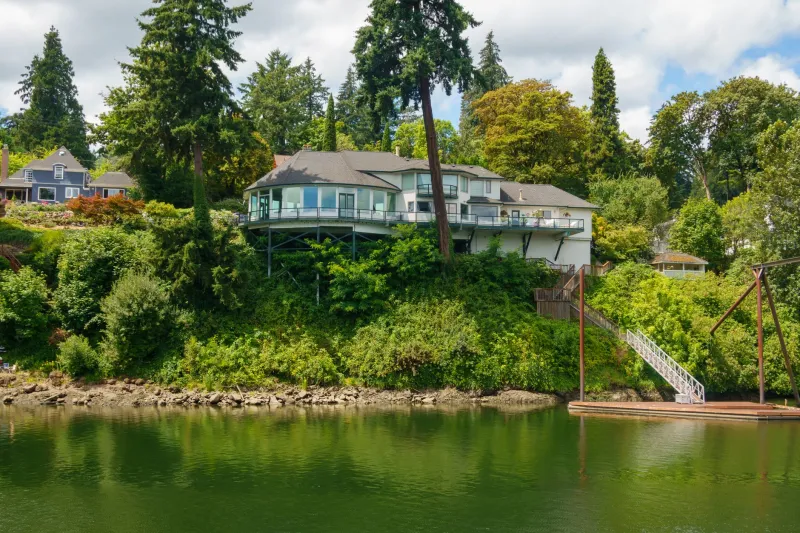
Contemporary riverside homes in flood-prone corridors — along the lower Mississippi, the Missouri River valley, and portions of the Tennessee and Cumberland — are being designed with elevated first floors that transform what might have been utilitarian crawl spaces or utility areas into dramatic architectural statements. Exposed concrete piers, steel moment frames, and engineered wood pilotis are being detailed with the same care applied to interior millwork. The space beneath the home becomes part of the composition: a covered outdoor living area, a carport with polished concrete flooring, or simply an unobstructed view corridor that connects the street to the river.
For properties where grade-level living is non-negotiable, wet-floodproofing techniques — designing lower levels to allow controlled inundation and drainage without structural damage — have advanced considerably. Flood-resistant materials including sealed concrete, marine-grade cabinetry, and porcelain tile eliminate the catastrophic loss associated with water intrusion, while mechanical and electrical systems are relocated to upper floors or elevated platforms as a matter of course.
Materials That Perform and Endure
The material palette of climate-adaptive luxury design is distinguished by a preference for durability without visual compromise. Architects working along America's rivers are increasingly specifying fiber cement cladding, Ipe and thermally modified wood, architectural concrete, and powder-coated aluminum — materials that resist moisture, UV degradation, and biological growth without demanding the intensive maintenance schedules of traditional wood siding or natural stone veneers.
Below grade, the emphasis shifts to waterproofing systems of uncommon sophistication. Crystalline waterproofing compounds applied to foundation concrete create a self-sealing barrier that activates upon contact with moisture — a technology borrowed from commercial and infrastructure construction and now finding its place in the residential luxury market. Drainage mat systems, sump redundancy, and radon-resistant construction are integrated as standard, not optional, components.
For roofing, standing-seam metal has become the preferred specification among architects prioritizing longevity and wind resistance. Metal roofs rated for 140-mph wind loads — relevant in river corridors subject to severe convective storms — are available in profiles and finishes indistinguishable from premium architectural standing seam, allowing performance and aesthetics to coexist without tension.
Erosion Control as Landscape Architecture
The riverbank itself is a dynamic, living boundary, and its management is among the most consequential decisions a waterfront homeowner makes. Erosion is not a hypothetical risk along many of America's premier rivers; it is an active, measurable process that can alter a property's relationship to the water within a single decade if left unaddressed.
The most sophisticated approaches to bank stabilization have moved decisively away from the traditional riprap — the dumped stone revetments that protect shorelines but do so at considerable aesthetic cost. In their place, bioengineered bank stabilization systems combine structural elements with native plantings to create shorelines that are simultaneously functional and beautiful. Live fascines, brush mattresses, and coir fiber rolls establish root systems that anchor soil while supporting the riparian habitat that defines a healthy river corridor.
For properties where more substantial protection is warranted, interlocking concrete block systems and articulated concrete mattresses provide high-capacity erosion resistance in profiles that can be vegetated and naturalized over time. The result, when executed well, is a riverbank that appears to have arrived at its current form through natural processes — a seamless transition from manicured landscape to living shoreline.
Smart Systems for an Uncertain Climate
The intelligent home has become the resilient home. Smart-home platforms are increasingly being configured not merely for convenience but for climate monitoring and emergency preparedness — a shift that reflects both the capabilities of current technology and the priorities of buyers who have witnessed, or studied, what prolonged flooding or severe storm events do to unprepared properties.
Real-time water level monitoring, integrated with USGS river gauge data and proprietary sensor arrays, allows homeowners to receive advance notice of rising water conditions — time that can mean the difference between a managed response and an emergency. Automated sump pump activation, motorized flood barriers for garage openings and lower-level entries, and generator transfer switches with whole-home backup capacity are now being specified as part of the initial construction package rather than added as afterthoughts.
HVAC systems designed for hurricane-rated enclosures, with equipment located on upper floors or in elevated mechanical rooms, eliminate one of the most common and expensive consequences of flooding: the loss of mechanical systems. Solar arrays paired with battery storage provide energy independence during grid outages — a feature that resonates with buyers who understand that climate events increasingly affect infrastructure well beyond the immediate property.
Resilience as a Value Proposition
The financial case for climate-adaptive design is becoming as compelling as the aesthetic one. Insurance markets for waterfront properties have tightened considerably, with carriers imposing higher premiums, reduced coverage limits, and in some cases withdrawal from certain coastal and riverine markets altogether. Properties built to exceed standard resilience benchmarks — documented through third-party certifications such as FORTIFIED Home or the Insurance Institute for Business and Home Safety's designation programs — are commanding meaningful insurance advantages and, increasingly, buyer premiums at the point of sale.
For the buyer approaching a luxury riverside acquisition with long-term ownership in mind, this calculus is straightforward. A home engineered to endure is not merely a more comfortable home. It is a more defensible investment — one that positions its owner advantageously regardless of how the climate, the river, or the insurance market evolves in the decades ahead.
At 226 Riverside, we observe this convergence of design excellence and engineering foresight as the defining characteristic of the finest waterfront properties coming to market today. The river has always rewarded those who approach it with respect. Now, it rewards those who approach it with intelligence.