Rediscovered Rivers: The Emerging Luxury Destinations Capturing High-Net-Worth Attention Beyond the Coasts
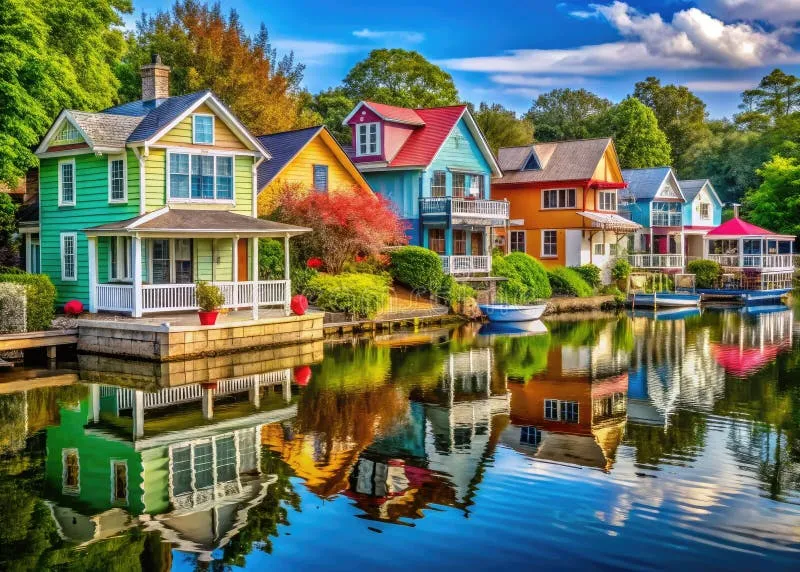
Photo: charming historic American river town waterfront with luxury homes and autumn foliage, via thumbs.dreamstime.com
A quiet but consequential shift is reshaping the geography of American luxury real estate. As coastal markets in Florida, California, and New England reach saturation — and as remote work liberates high-net-worth buyers from proximity requirements — a new class of riverside destination is emerging in their wake. Storied river towns with authentic architectural character, manageable scale, and dramatic natural settings are attracting a wave of sophisticated capital that is transforming local markets with remarkable speed.
The buyers leading this migration are not seeking the familiar markers of established luxury enclaves. They are seeking something rarer: prestige paired with authenticity, privacy paired with cultural vitality, and investment value paired with genuine livability.
The Saturation Problem in Established Markets
The dynamics driving this migration are not difficult to understand. The median sale price for a waterfront home in Palm Beach County exceeded $3.2 million in 2023, according to data from the Florida Realtors Association. Comparable properties along the Hamptons shoreline on Long Island routinely transact above $10 million. In Marin County, California, the combination of land scarcity and regulatory constraint has produced a market where even modest waterfront parcels carry aspirational price tags.
For buyers with the financial capacity to participate in these markets, the calculus has shifted. The question is no longer simply whether they can afford a premier coastal address — it is whether that address continues to represent the optimal deployment of capital, lifestyle, and identity. For a growing cohort, the answer has become nuanced.
River towns offer a compelling alternative proposition: comparable or superior natural beauty, dramatically lower acquisition costs, less congested infrastructure, and the particular social currency of having identified a destination before the broader market arrived.
The Towns Drawing Sophisticated Capital
Several specific markets have emerged as focal points for this migration, each distinguished by a combination of physical beauty, historical character, and improving accessibility.
Shepherdstown, West Virginia, situated on a bend of the Potomac River approximately 75 miles from Washington, D.C., has quietly attracted a cohort of buyers from the federal policy world, technology sector, and cultural institutions. The town's 18th-century streetscape, proximity to the C&O Canal National Historical Park, and access to Harpers Ferry have made it a destination of uncommon distinction. Riverfront parcels here, which traded in the low six figures a decade ago, are now regularly commanding prices that reflect the area's emerging prestige.
Stillwater, Minnesota, positioned on the St. Croix River northeast of the Twin Cities, represents a different but equally compelling profile. A designated National Scenic Riverway provides the St. Croix with a degree of environmental protection that many buyers find deeply reassuring — the natural character of the corridor is, in meaningful ways, legally protected. Stillwater's Victorian commercial district, active arts community, and proximity to Minneapolis-St. Paul International Airport have attracted a wave of buyers from the technology and healthcare sectors who are willing to pay significant premiums for riverfront parcels with direct water access.
Natchez, Mississippi, overlooking a dramatic bluff above the Mississippi River, occupies a different position in this emerging landscape. Its inventory of antebellum plantation estates — many requiring substantial renovation investment — has attracted buyers who combine an appetite for historical preservation with the financial capacity to execute it. The resulting transactions represent some of the most architecturally significant luxury acquisitions in the American South, and the town's profile as a cultural destination has grown accordingly.
Bend, Oregon's Deschutes River corridor, while increasingly well-known, continues to offer riverfront acquisition opportunities that compare favorably to the Pacific Coast markets it has partially supplanted in buyer preference. The combination of outdoor recreational culture, a maturing culinary and arts scene, and reliable air service from Redmond has made the Deschutes corridor a consistent target for technology wealth relocating from the Bay Area and Seattle.
What the Pricing Data Reveals
The pricing trajectories in these markets tell a consistent story. Between 2019 and 2024, riverfront property values in emerging inland destinations outpaced coastal luxury market appreciation in several key metrics, according to data aggregated from county assessor records and brokerage transaction reports.
In the St. Croix Valley, riverfront residential properties appreciated at a compound annual rate exceeding 11 percent over this period. Along the upper Potomac corridor in West Virginia and western Maryland, comparable metrics approached 9 percent annually — a figure that would have seemed implausible to local market participants as recently as 2017.
What is particularly notable is the composition of buyers driving this appreciation. Unlike earlier waves of rural and exurban migration driven primarily by affordability, the current cohort entering these markets includes buyers with household net worths well above $10 million who are making deliberate, values-driven choices about where they wish to anchor their primary or secondary residences.
The Infrastructure Catalyst
No analysis of these markets is complete without acknowledging the role of infrastructure investment — both physical and digital — in enabling their transformation. The expansion of high-speed broadband into rural river corridors, accelerated by federal investment through the Infrastructure Investment and Jobs Act, has fundamentally changed the calculus for buyers who require reliable connectivity for professional purposes.
Simultaneously, the expansion of regional jet service to smaller airports — Hagerstown Regional in Maryland, La Crosse Regional in Wisconsin, Natchez-Adams County in Mississippi — has reduced the effective isolation of many river towns to a degree that would have been inconceivable before the proliferation of regional aviation. A buyer in Shepherdstown can reach Reagan National Airport in under 90 minutes by road. A resident of Stillwater is 35 minutes from a major international hub.
Authenticity as a Luxury Asset
Perhaps the most interesting dimension of this migration is what it reveals about the evolving preferences of ultra-high-net-worth buyers. The established markers of luxury — the oceanfront address, the brand-name enclave, the trophy property in a recognized resort market — retain their appeal for a segment of the market. But for a growing number of sophisticated buyers, these markers have become associated with crowding, homogeneity, and diminishing returns.
The river towns attracting the most serious attention today offer something that no amount of capital can manufacture in a mature coastal market: genuine historical character, intact natural ecosystems, and the particular satisfaction of belonging to a community that has not yet been fully discovered.
For buyers with the vision to recognize these qualities and the patience to allow a market to mature around them, the emerging river corridors of America represent a rare convergence of lifestyle value and investment opportunity — the kind that, by definition, does not remain available indefinitely.