The Inland Advantage: Why America's River Corridors Are Becoming the New Frontier for Luxury Real Estate Investment
The conventional geography of American luxury real estate has long been organized around coastlines. The Hamptons, Palm Beach, Malibu, Nantucket — these names function less as place references than as shorthand for a particular category of aspiration. Yet the past several years have introduced a meaningful disruption to this coastal orthodoxy, one that the most astute investors in the high-end residential market have been tracking with considerable interest.
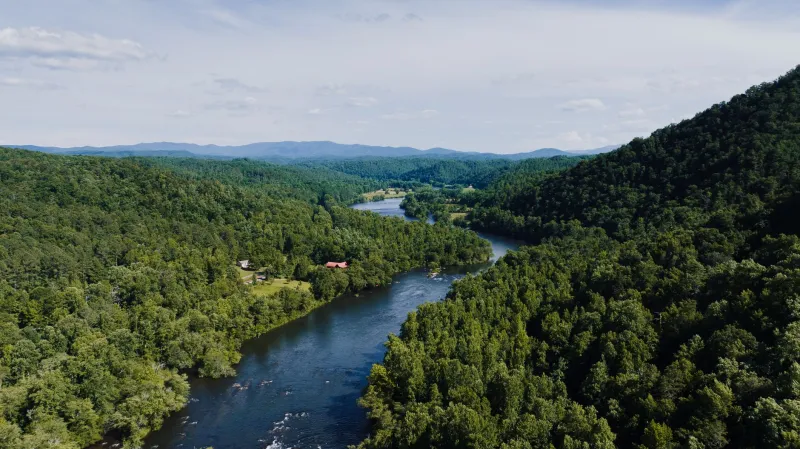
America's inland river corridors — the Tennessee, the Hudson, the Ohio, the upper Mississippi, the James — are generating price appreciation, institutional interest, and buyer enthusiasm that rival, and in some cases surpass, what is being observed in the established coastal enclaves. The reasons are structural, not cyclical, and they merit serious examination.
The Affordability Gap That Isn't a Compromise
The entry-level conversation about secondary river markets invariably begins with price. The numbers are, by any measure, striking. A waterfront estate on the Tennessee River's Guntersville Lake corridor — where the water is wide, the scenery is genuinely dramatic, and the infrastructure for boating and outdoor recreation is exceptional — can be acquired for a fraction of what a comparable footprint on the Connecticut shoreline or the North Carolina Outer Banks would command. The same calculus applies along the upper Hudson Valley, where properties offering river views, historic architectural character, and proximity to New York City trade at discounts that experienced investors describe as anomalous.
But framing this differential purely as affordability misses the more important point. For the buyer who has already demonstrated the capacity to compete in primary coastal markets, the secondary river market represents not a budget accommodation but an allocation decision. The question is not whether one can afford the Hamptons. It is whether the Hamptons — with its density, its seasonality, its exposure to storm surge, and its increasingly complex insurance environment — represents the optimal deployment of luxury residential capital.
For a growing cohort of high-net-worth buyers, the answer is no.
Institutional Signals: Following the Smart Money
When institutional capital moves into a residential real estate segment, it rarely does so without substantial prior analysis. The quiet accumulation of luxury riverside assets by family offices, real estate investment trusts with residential components, and private equity-backed hospitality developers over the past three years is, accordingly, worth noting.
The Tennessee River corridor — particularly the stretch running through northeast Alabama and into Tennessee — has attracted several notable hospitality and residential development projects targeting the ultra-high-net-worth market. The Hudson Valley, long a destination for the culturally sophisticated second-home buyer, has seen a pronounced acceleration in luxury renovation activity and new construction on river-adjacent parcels. Along the James River in Virginia, the convergence of Richmond's expanding tech and finance employment base with the area's deep historical identity and exceptional outdoor recreation access has produced a market that institutional observers are monitoring closely.
The common thread across these markets is a set of fundamentals that coastal markets have largely depleted: available land, regulatory environments that — while not without complexity — remain more navigable than those governing oceanfront development, and price-to-quality ratios that still favor the buyer.
What the Data Reveals
Price appreciation data from secondary river markets over the five-year period ending in 2023 tells a compelling story. Luxury residential properties — defined here as those in the top decile of local market pricing — along the Tennessee River corridor appreciated at annualized rates exceeding those recorded in several established coastal luxury markets during the same period. The Hudson Valley's luxury segment demonstrated similar outperformance, driven in part by pandemic-era migration patterns that introduced a new class of buyer to the region and established price floors that have proven durable.
Perhaps more telling than appreciation rates is the compression of days on market for well-positioned riverside properties in these corridors. Properties that would have sat for months a decade ago are now trading in days when priced correctly — a signal that demand has structurally deepened rather than merely spiked.
Inventory constraints further support the investment thesis. The supply of genuinely premium riverfront parcels in these markets is finite and, in many cases, declining as existing owners recognize the appreciation potential they hold. The buyer who moves with conviction today is acquiring ahead of a scarcity dynamic that will only intensify.
Lifestyle as Infrastructure: Why These Markets Retain Buyers
Investment theses that rely solely on price appreciation are inherently fragile. The secondary river market story is strengthened considerably by the lifestyle infrastructure these communities have developed — infrastructure that creates the kind of sustained demand that supports long-term value.
The Tennessee Valley's recreational ecosystem — its interconnected system of TVA lakes and rivers offering boating, fishing, and water sports of a quality that many coastal destinations cannot match — has become a genuine attractor for buyers whose primary criterion is access to water-based recreation rather than proximity to a specific urban center. Chattanooga, which anchors the Tennessee River's most dynamic real estate corridor, has invested substantially in its riverfront and earned recognition as one of the most livable mid-sized cities in the country — a designation that carries real weight with the remote-work-enabled buyer evaluating full-time relocation.
The Hudson Valley brings a different but equally compelling set of lifestyle assets: a culinary scene anchored by James Beard-recognized restaurants, a visual arts community of national significance, proximity to New York City without immersion in it, and a built environment that layers centuries of architectural history against a river that inspired America's first school of landscape painting. These are not incidental qualities. They are the foundations of enduring desirability.
Along the James River, buyers are finding a market where historic estates on substantial acreage — properties that would be prohibitively priced in Fairfield County or Westchester — remain accessible, and where the river itself provides a recreational corridor that rivals anything the mid-Atlantic coast can offer.
The Risk-Adjusted Case for River Markets
No investment analysis is complete without a candid accounting of risk. Secondary river markets are not without their complexities: floodplain exposure, the need for sophisticated due diligence on riparian rights and dock permitting, and the occasional illiquidity of markets where the buyer pool, while growing, remains narrower than in primary coastal destinations.
Against these considerations, however, must be weighed the risks that have become increasingly associated with primary coastal markets: hurricane and storm surge exposure, the accelerating retreat of private insurance carriers from coastal Florida and the Carolinas, sea-level rise projections that introduce genuine long-term uncertainty to oceanfront valuations, and the crowd dynamics that have made the most desirable coastal enclaves simultaneously expensive and, for many buyers, less pleasurable than they once were.
The sophisticated investor who approaches the secondary river market with appropriate diligence — retaining counsel experienced in riparian law, engaging environmental consultants familiar with local floodplain dynamics, and working with advisors who understand the specific micromarkets within these corridors — will find a risk-adjusted opportunity that the current moment may not offer indefinitely.
At 226 Riverside, we have long understood that the most compelling waterfront experiences in America are not confined to its edges. The rivers that run through this country's interior carry their own history, their own beauty, and increasingly, their own investment logic. The buyers who recognize this earliest will, in all likelihood, be most pleased with what they find.